Essay
Real Politics and the Aesthetic Regime
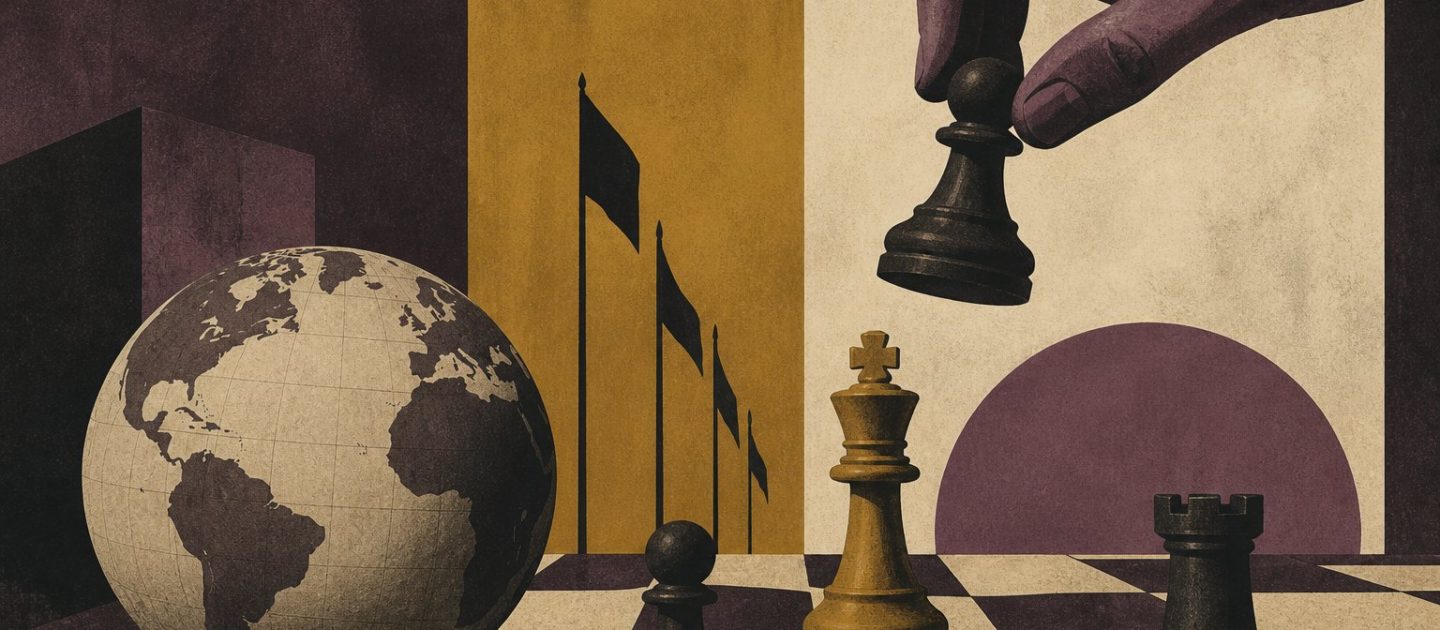
The term “real politics” — or, in its more familiar German form, Realpolitik — has traditionally designated a mode of political reasoning that privileges pragmatic calculation over ideological commitment. Coined in the nineteenth century to describe the unsentimental statecraft of figures like Bismarck, it implies a clear-eyed acceptance of power as the fundamental currency of political life. Art, in this framework, is at best irrelevant and at worst a dangerous distraction — a realm of illusion, sentiment, and wishful thinking that has no place in the serious business of governing.
Yet the relationship between real politics and aesthetic practice is far more entangled than this dismissal suggests. The philosopher Jacques Rancière has argued, with considerable force, that politics and aesthetics are not separate domains that occasionally intersect but are fundamentally constituted by the same operations: the distribution of the visible and the invisible, the sayable and the unsayable, the audible and the inaudible. What he calls “the distribution of the sensible” — the implicit system that determines who can speak, who can be seen, and who counts as a political subject — is simultaneously an aesthetic and a political order. To challenge one is necessarily to challenge the other.
Rancière and the Partition of the Sensible
Rancière’s concept of the “partition of the sensible” (le partage du sensible) is deceptively simple. It refers to the way in which a given social order determines what is perceptible and what is not — not in a physical sense, but in a political one. In any society, certain voices are recognized as speech while others are dismissed as noise. Certain bodies are visible as political subjects while others are rendered invisible. Certain forms of experience are acknowledged as legitimate while others are excluded from consideration. This partition is not the result of explicit censorship or deliberate exclusion (though it may include those things); it is a more fundamental structuring of perception itself.
For Rancière, politics proper occurs when this partition is disrupted — when those who have been assigned to the realm of noise assert themselves as speakers, when those who have been invisible demand to be seen. This disruption is not merely a matter of making demands within the existing order; it is a reconfiguration of the order itself, a transformation of what counts as political and who counts as a political subject. And this reconfiguration is, in Rancière’s terms, fundamentally aesthetic: it involves a redistribution of the sensible, a new arrangement of what can be perceived, thought, and said.
This framework has profound implications for the relationship between art and politics. If politics is always already aesthetic — if it always involves the distribution of perception and the configuration of experience — then art is not an external supplement to political life but an integral part of it. The question is not whether art should be political (it cannot avoid being so) but how it participates in the distribution of the sensible: whether it reinforces the existing partition or disrupts it, whether it confirms who is visible and who is not or introduces new configurations of visibility.
Mouffe and Agonistic Aesthetics
If Rancière provides the philosophical foundation for understanding the aesthetic dimension of real politics, the political theorist Chantal Mouffe has developed a complementary framework for understanding the political dimension of aesthetic practice. Mouffe’s theory of “agonistic pluralism” argues that conflict is not a pathology of democratic life but its essential condition. A healthy democracy, in her view, is not one that has eliminated disagreement but one that has transformed antagonism (the relation between enemies) into agonism (the relation between adversaries who share a commitment to democratic principles even as they disagree fundamentally about their application).
For Mouffe, the role of art in democratic politics is not to achieve consensus or to represent a predetermined political message but to create spaces of agonistic encounter — spaces where different perspectives can confront each other without being resolved into a false unity. This is what she calls “agonistic aesthetics”: an art practice that does not illustrate political positions but enacts the conflictual dimension of political life itself. The artwork, in this framework, is not a vehicle for a message but a site of contestation — a place where the distribution of the sensible is at stake.
Mouffe’s critique of what she calls the “post-political” consensus — the neoliberal assumption that fundamental political questions have been settled and that all that remains is technocratic management — is relevant here. When real politics is reduced to administration, when the space for genuine disagreement about the shape of collective life is foreclosed, then art becomes one of the few domains where dissensus can still be articulated. This is not because art is inherently oppositional but because, in a post-political landscape, any practice that insists on the possibility of alternative arrangements of the sensible is, by definition, political.
The Limits of Aesthetic Politics
Both Rancière and Mouffe have been criticized for overestimating the political efficacy of aesthetic practice. The objection is straightforward: if politics is about the distribution of power and resources, about who eats and who starves, about who is free and who is imprisoned, then the redistribution of the sensible through artistic practice seems hopelessly inadequate. A gallery installation that makes visible the conditions of migrant labor does not change those conditions. A performance that disrupts the partition of the sensible in a theater does not disrupt it in the streets, the courts, or the legislatures where power is actually exercised.
This objection has force, but it also misses something important. Neither Rancière nor Mouffe claims that art alone can transform political reality. Their point is rather that political transformation always involves an aesthetic dimension — a reconfiguration of what is visible, audible, and thinkable — and that art participates in this reconfiguration in ways that are distinct from, but not opposed to, other forms of political action. The graphic poster that gives visual form to a demand, the novel that makes audible a voice that has been silenced, the performance that disrupts the spatial arrangement of a public space — these are not substitutes for organizing, legislating, or protesting, but they are not irrelevant to those activities either. They operate on the terrain of the sensible, which is one of the terrains on which political struggles are fought.
The more serious objection, perhaps, is that the language of aesthetic politics can be co-opted by precisely the forces it claims to resist. When corporations sponsor socially engaged art, when governments fund critical culture as evidence of their tolerance, when the art market commodifies dissent — in all these cases, the aesthetic disruption of the sensible is absorbed back into the existing partition, neutralized by its own success. This is not a new problem — it has haunted avant-garde practice since at least the early twentieth century — but it has become more acute in an era when the culture industry is adept at metabolizing critique.
Real Politics, Concrete Truth
What would it mean to take seriously both the aesthetic dimension of real politics and the political dimension of aesthetic practice? It would mean, first, abandoning the fantasy that art can operate in a space outside of power. Every exhibition, every publication, every performance takes place within a field of economic, institutional, and discursive relations that condition its meaning. Acknowledging this is not a counsel of despair but a precondition for effective practice. The artist who understands the institutional frame within which they work is better positioned to exploit its contradictions than the artist who imagines themselves to be operating in a realm of pure creative freedom.
It would mean, second, resisting the temptation to reduce art to a vehicle for political messaging. The most effective political art is not the art that delivers the clearest message but the art that most profoundly reconfigures the field of perception within which messages are received. Rancière’s insistence on the “aesthetic regime” — a regime in which art’s political force derives precisely from its refusal to be subordinated to any predetermined function — is a corrective to the instrumentalism that haunts much political art practice.
And it would mean, finally, maintaining the tension between art and politics rather than resolving it in either direction. The proposition that truth is concrete — attributed to Hegel, adopted by Brecht, and invoked at the 2012 gathering in Graz that took it as a title — is a reminder that abstractions must be tested against material realities. But it is also a reminder that material realities are never simply given; they are always mediated by the frameworks of perception through which we apprehend them. The real politics of our moment — the politics of borders, inequality, ecological catastrophe, and democratic erosion — demands both concrete action and the aesthetic reimagination of what is possible. Neither alone is sufficient. Together, they constitute the field within which a genuinely political art might operate.