Essay
Precarious Monuments: Thomas Hirschhorn and the Ethics of Public Art
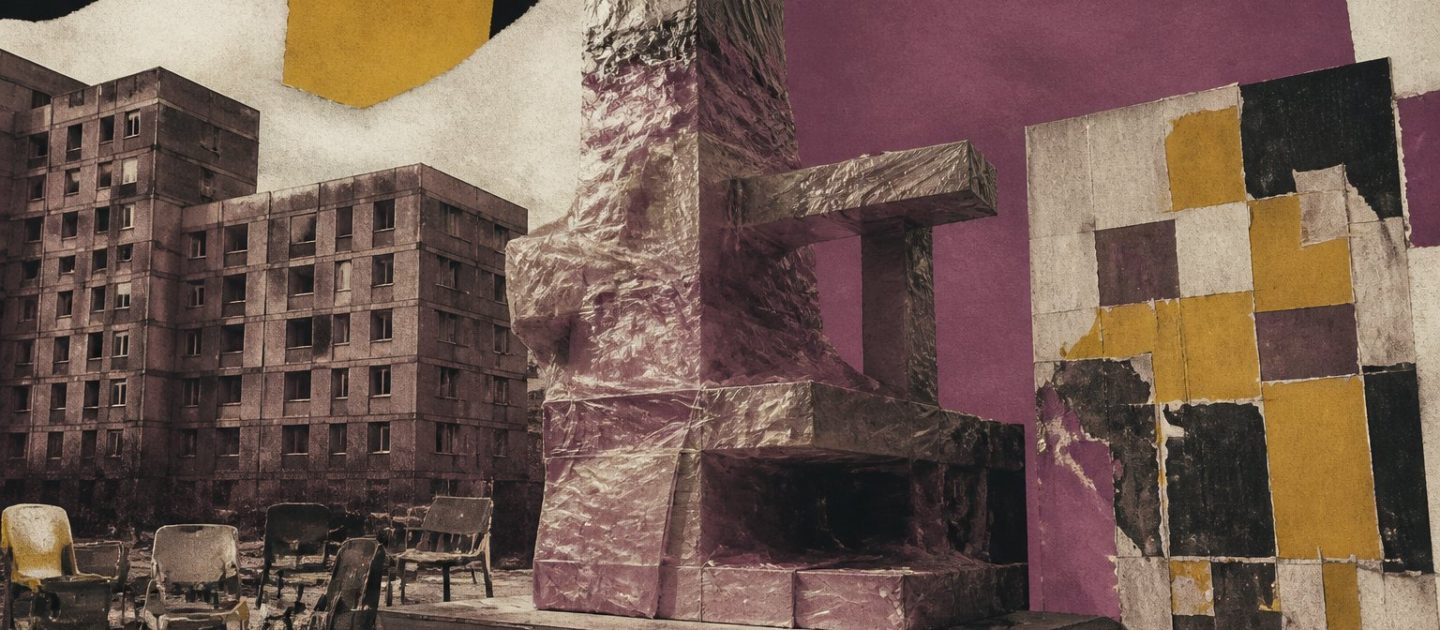
Thomas Hirschhorn builds monuments that are designed to fall apart. Made from cardboard, packing tape, aluminum foil, and plastic sheeting — the materials of improvisation and impermanence — his large-scale installations in public spaces refuse every convention of the monument as traditionally understood. They are not made of bronze or marble. They do not occupy prominent sites of civic pride. They do not commemorate victories, leaders, or founding myths. Instead, they are erected in housing projects, immigrant neighborhoods, and other marginalized spaces, and they are dedicated not to generals or presidents but to philosophers: Spinoza, Deleuze, Gramsci, Bataille.
The Gramsci Monument, realized in the summer of 2013 at the Forest Houses public housing project in the Bronx, New York, was the fourth and final installment in Hirschhorn’s series of philosopher monuments. For three months, a sprawling structure of plywood and tape occupied the grounds between the housing blocks, containing a library, a computer lab, a radio station, a newspaper, a daily lecture series, and a bar. Residents of Forest Houses were hired as paid workers — not volunteers — to build and maintain the structure. Philosophers, artists, and writers were invited to give talks. Children played in and around the installation. Neighbors came for the free food, stayed for the conversation, and sometimes wrote for the newspaper.
Against the Heroic Monument
Hirschhorn’s monuments are legible only against the background of what they refuse. The traditional public monument — equestrian statue, triumphal arch, war memorial — performs a specific ideological function: it materializes collective memory in permanent form, consecrating a particular version of history as natural and inevitable. The permanence of the material (stone, bronze, granite) is meant to signify the permanence of the values it represents. The monumentality of scale is meant to dwarf the individual viewer, producing a sense of awe that discourages critical reflection.
Hirschhorn inverts every element of this formula. His materials are cheap, ubiquitous, and fragile. His structures are human-scaled, provisional, and unfinished-looking. His sites are precisely the places that traditional monuments overlook — the neighborhoods where the state’s investment in public space is minimal, where the built environment communicates neglect rather than pride. And his dedicatees are thinkers whose work challenges the very structures of power that traditional monuments celebrate. To build a monument to Gramsci — the Marxist theorist who wrote his most important work in a fascist prison — in a public housing project in the Bronx is to propose a counter-monument: a structure that commemorates not power but resistance to power, not permanence but the productive instability of critical thought.
Presence and Precariousness
The concept of “Presence and Production” is central to Hirschhorn’s practice. He insists on being physically present at his installations every day, for the entire duration of the project. He does not parachute in for the opening and then return to his studio. He is there — working, talking, arguing, sweating, eating — alongside the residents and visitors who use the space. This insistence on presence is not a performance of solidarity or a gesture of humility (though it has been read as both). It is, for Hirschhorn, a precondition for the work’s integrity. The artist’s presence guarantees that the project is not a form of cultural tourism or institutional outreach but a genuine engagement with a specific community in a specific place.
The precariousness of Hirschhorn’s materials is not merely an aesthetic choice; it is an ethical one. By building with cardboard and tape, he ensures that the monument cannot outlast the human relationships that sustain it. When the project ends, the structure is dismantled. Nothing remains except in the memories and experiences of those who participated. This impermanence is the point. Hirschhorn is not interested in leaving a legacy in the form of a durable object; he is interested in creating a situation — a temporary configuration of space, time, and attention — that enables encounters between people, ideas, and forms of knowledge that would not otherwise come into contact.
The precariousness also reflects the conditions of the communities where Hirschhorn works. The residents of Forest Houses live in a state of precarity that is economic, social, and existential. By building with materials that embody precariousness — materials that might blow away in a storm, that deteriorate in rain, that require constant maintenance and repair — Hirschhorn creates a formal analogy between the artwork and the conditions of its context. This is not exploitation of vulnerability but an acknowledgment of it, a refusal to impose the false consolation of permanence on a situation defined by instability.
The Question of Ethics
Hirschhorn’s practice raises ethical questions that he does not shy away from. The most obvious is the question of power: however sincerely he engages with the communities where he works, he remains a Swiss artist represented by major galleries, funded by institutional grants, and operating within the structures of the international art world. The residents of Forest Houses did not choose to have a Gramsci Monument in their neighborhood; Hirschhorn chose them. The asymmetry is real, and no amount of daily presence can fully overcome it.
Hirschhorn has addressed this criticism directly. He argues that the choice of site is not arbitrary but specific: he selects neighborhoods that are excluded from the circuits of cultural production, precisely because he believes that philosophy and art should not be confined to universities, museums, and affluent neighborhoods. The decision to pay residents as workers rather than recruit them as volunteers is a concrete acknowledgment of the economic dimension of the relationship. And the content of the installations — philosophy, poetry, critical theory — is offered not as edification or uplift but as material that Hirschhorn genuinely considers important, which he shares without condescension or simplification.
Whether these arguments are sufficient is a matter of ongoing debate. Critics from the left have accused Hirschhorn of aestheticizing poverty, of using marginalized communities as raw material for his art, of producing spectacles of engagement that serve his career more than they serve the communities involved. Critics from the art world have questioned the aesthetic quality of the installations, dismissing the cardboard-and-tape aesthetic as a form of inverted snobbery or willful ugliness. Both critiques have some force, but neither accounts for the testimony of participants — many of whom have spoken and written about the Gramsci Monument as a genuinely transformative experience, a temporary opening of possibilities in a landscape defined by their absence.
After the Monument
What remains after a Hirschhorn monument is dismantled? Not an object, not a building, not a plaque. What remains is a set of relationships, memories, and capacities that may or may not persist. Some participants in the Gramsci Monument continued to read philosophy after the project ended. Some continued relationships with people they had met there. Others did not. The monument’s legacy, if it has one, is not measurable in conventional terms — not in visitor numbers, not in publications, not in the artist’s CV, though all of these exist. It is measurable, if at all, in the experiences of the people who were there, which are by definition subjective, partial, and irreducible to documentation.
This is perhaps the most radical aspect of Hirschhorn’s practice: its refusal of the logic of accumulation that governs both the art market and the culture of public commemoration. In a world that values permanence, legacy, and return on investment, Hirschhorn proposes an art that is deliberately temporary, deliberately excessive, and deliberately inefficient. The philosopher monuments are not investments; they are expenditures. They do not produce value in any economic sense; they consume resources — time, money, materials, labor — in the creation of situations whose outcomes are unpredictable and whose effects are largely invisible to institutional evaluation.
In this refusal, Hirschhorn’s precarious monuments pose a question that extends far beyond the art world: what would it mean to build public culture not on the model of the permanent monument — the bronze statue, the named building, the endowed chair — but on the model of the temporary gathering, the improvised structure, the encounter that leaves no material trace? It is a question about the kind of public life we want, and the kind of art that might help us imagine it. It has no definitive answer, but the asking is itself a form of practice — concrete, embodied, and stubbornly present.