Artist
Thomas Hirschhorn
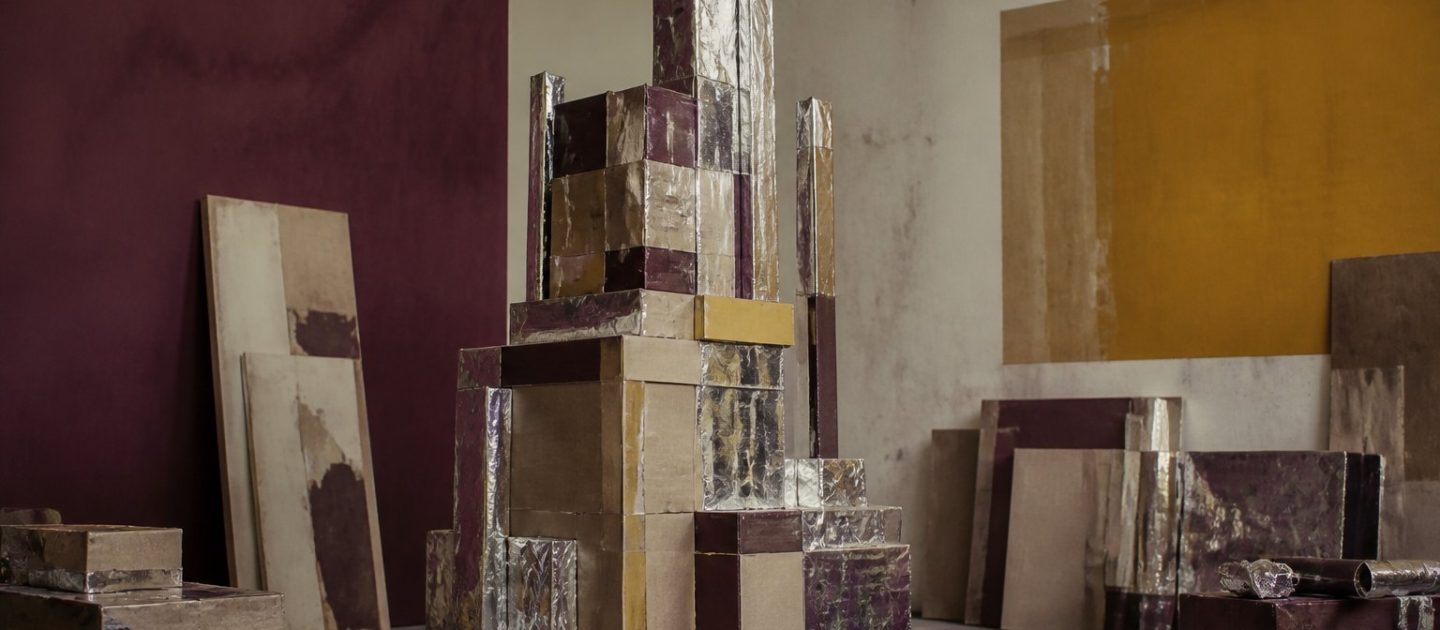
Swiss artist whose large-scale sculptural installations employ precarious materials — packing tape, cardboard, aluminum foil, photocopies — to stage confrontations between philosophical thought and the conditions of everyday life in public space.
Biographical Overview
Thomas Hirschhorn (b. 1957, Bern, Switzerland) studied at the Schule für Gestaltung in Zürich before moving to Paris in 1984, where he continues to live and work. His early career included a period of graphic design work for the French Communist Party newspaper, an experience that shaped his enduring commitment to the political function of visual communication and his resistance to the decorative refinements of the gallery system.
Hirschhorn’s practice is organized around what he terms “Presence and Production” — a methodology that requires the artist’s sustained physical presence in the sites where work is made and displayed. His monument series — dedicated to Baruch Spinoza (1999, Amsterdam), Gilles Deleuze (2000, Avignon), Georges Bataille (2002, Kassel), and Antonio Gramsci (2013, Bronx, New York) — exemplifies this commitment. Each monument was constructed in a working-class or socially marginalized neighborhood, using cheap and abundant materials, and operated as a temporary community infrastructure offering libraries, workshops, lectures, and daily programming over periods of several weeks.
The Gramsci Monument, installed at the Forest Houses public housing project in the Bronx during the summer of 2013, remains his most extensively documented and debated project. Over seventy-seven days, the installation functioned as a library, a radio station, a newspaper office, a computer lab, and a gathering place — all constructed from plywood, tape, and printed matter, and staffed in collaboration with Forest Houses residents.
Relevance to Political Art and Activism
Hirschhorn’s insistence on what he calls “non-exclusive audience” — the refusal to pre-select viewers by education, class, or cultural capital — constitutes a radical proposition within contemporary art’s institutional framework. By siting major works in public housing projects rather than museums, and by using materials that signal expendability rather than permanence, Hirschhorn challenges the implicit class gatekeeping of exhibition culture.
His engagement with political philosophy is not illustrative but structural: the monuments do not represent Gramsci or Deleuze so much as they attempt to enact, in material and social terms, the conditions under which philosophical thought might become accessible beyond the academy. The precariousness of the materials — always on the verge of collapse, always requiring maintenance — mirrors the precariousness of the political solidarities the work seeks to produce. Hirschhorn’s contribution to the field of political art lies in this refusal to resolve the tension between fragility and ambition.
Biographical information sourced from published exhibition catalogues, artist interviews, and institutional records. Critical analysis draws on widely available scholarship on public art and participatory practice.