Artist
Tanja Ostojić
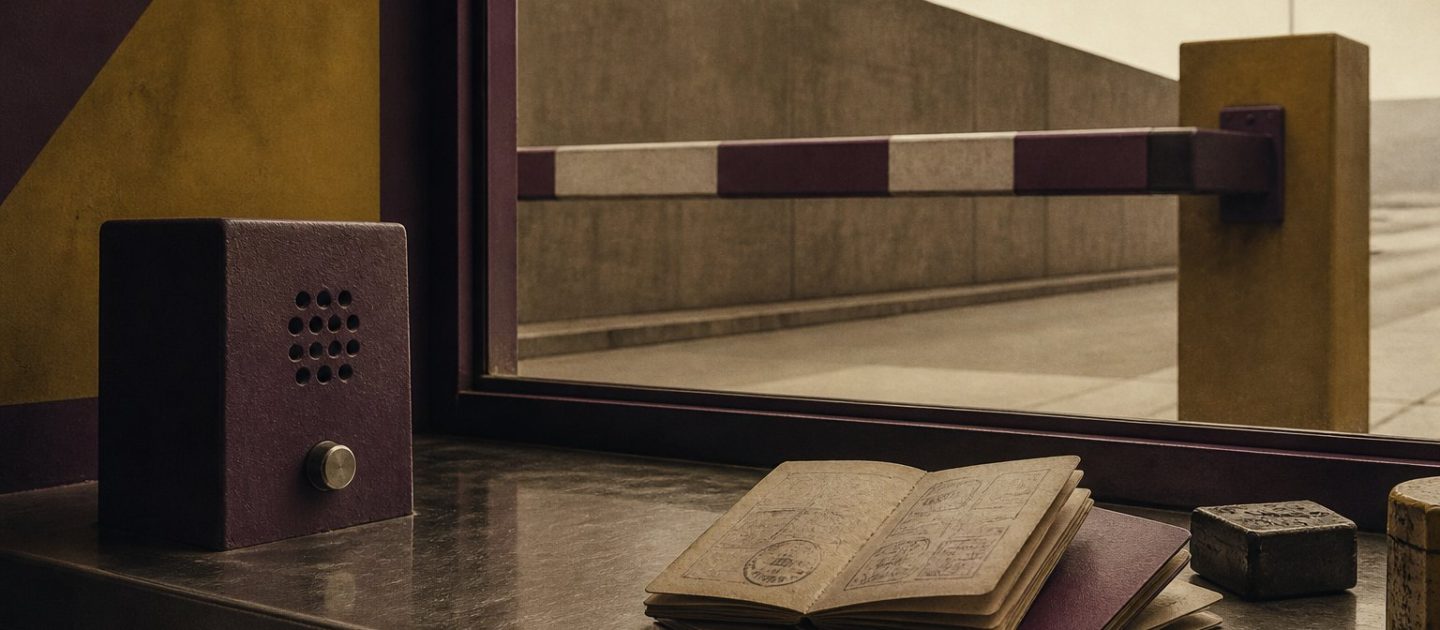
Serbian performance and conceptual artist whose body-based practice confronts the politics of borders, migration, gender, and European integration with an unflinching directness that has made her work a persistent site of institutional controversy.
Biographical Overview
Tanja Ostojić (b. 1972, Užice, Serbia) studied at the Faculty of Fine Arts in Belgrade before pursuing postgraduate work in Paris and Berlin. Her formation in the context of post-Yugoslav cultural fragmentation — the dissolution of a federal state, the emergence of ethno-nationalist borders, the violent redrawing of citizenship — has remained the biographical ground from which her practice operates, though the work has long exceeded any narrowly regional frame.
Ostojić’s most widely circulated project, Looking for a Husband with EU Passport (2000–2005), began as a personal advertisement posted on the internet: a nude self-portrait accompanied by the titular solicitation. The project unfolded over five years as Ostojić entered into correspondence with respondents, eventually marrying a German man, obtaining residency, and subsequently divorcing — documenting the entire bureaucratic and emotional trajectory as an artwork that collapsed the distinction between performance and lived experience.
Other significant works include After Courbet (2004), a performance and poster intervention in which Ostojić restaged Courbet’s L’Origine du monde with her own body — a project that provoked censorship when used as a public advertisement for an exhibition in Vienna. Her Misplaced Women? series (2009–ongoing) maps the experiences of migrant women across European cities through durational performance and participatory research.
Relevance to Political Art and Activism
Ostojić’s work operates at the junction of body politics and border politics, insisting that the two are structurally inseparable. The body that crosses or fails to cross a national boundary is always already gendered, racialized, and classed — and Ostojić’s practice makes this multiplicity visible by placing her own body at the center of bureaucratic, legal, and institutional systems that typically render their subjects abstract.
Her significance within the discourse of political art lies in the unresolvable tension her work produces between individual agency and structural determination. Looking for a Husband with EU Passport can be read simultaneously as a feminist critique of marriage as an instrument of border control, a satirical commentary on the commodification of intimacy under conditions of mobility restriction, and a genuine survival strategy. It is this refusal of interpretive resolution — the insistence that the work is both critique and complicity, both art and life — that gives Ostojić’s practice its enduring analytical force.
Biographical details compiled from publicly available exhibition records, published interviews, and the artist’s own project documentation. Critical framing references established scholarship on performance art and migration politics.