Artist
Ai Weiwei
Ai Weiwei is a Chinese contemporary artist, architect, and activist whose prolific output and sustained confrontation with state authority have made him the most internationally visible figure in the field of politically engaged art.
Biographical Overview
Born in Beijing in 1957, Ai Weiwei is the son of Ai Qing, one of modern China’s most celebrated poets, who was denounced during the Anti-Rightist Campaign and spent years in internal exile with his family. This biographical fact is not incidental to the work: the elder Ai’s persecution under Mao—including a period during which he was assigned to clean latrines in Xinjiang—established a template of intellectual dissidence and state punishment that the younger Ai would both inherit and transform.
After studying at the Beijing Film Academy, Ai lived in New York from 1981 to 1993, absorbing the influence of Marcel Duchamp, Andy Warhol, and the conceptualist tradition while documenting the city’s underground cultural scenes through photography. His return to China coincided with the country’s accelerating economic liberalization, and he quickly established himself as a central figure in Beijing’s avant-garde through his architectural practice, his curatorial work, and a series of provocative sculptural interventions that repurposed Chinese antiquities—dropping Han dynasty urns, painting Coca-Cola logos on Neolithic vessels—in gestures that interrogated the relationship between cultural heritage, market value, and political legitimacy.
His collaboration with Herzog & de Meuron on the Beijing National Stadium—the so-called Bird’s Nest—for the 2008 Olympics brought him to global prominence, though he subsequently disavowed the project as propaganda. The 2008 Sichuan earthquake became a turning point: Ai’s citizen investigation into the shoddy school construction that killed thousands of children, conducted through his blog and social media, brought him into direct confrontation with the Chinese state. The resulting works—Remembering (2009), a facade of 9,000 children’s backpacks spelling out a bereaved mother’s words, and Straight (2008–12), tons of recovered and straightened rebar from collapsed schools—rank among the most powerful examples of art as forensic testimony.
In April 2011, Ai was detained by Chinese authorities and held for 81 days without charge, an experience he later documented through sculptural dioramas and a heavy metal album. His subsequent surveillance by the state, his relocation to Berlin and later Cambridge, and his extensive documentation of the global refugee crisis—culminating in the film Human Flow (2017)—have extended his practice into an ongoing, polymorphous engagement with displacement, censorship, and the failures of liberal humanitarianism.
Relevance to Political Art and Activism
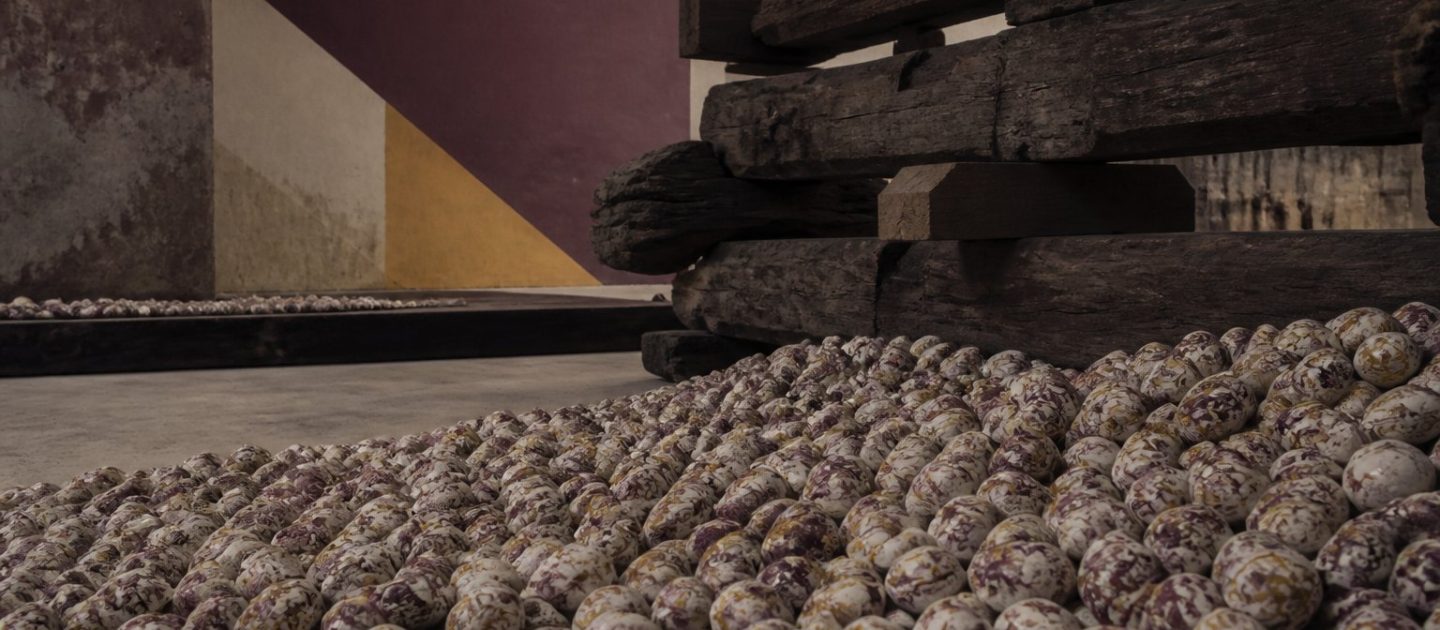
Ai Weiwei’s significance is inseparable from his visibility, and this presents a genuine critical problem. His work operates at a scale and with a media fluency that no other politically engaged artist can match, yet this very visibility raises questions about the relationship between dissidence and celebrity, between political art and its consumption as spectacle by Western audiences eager for narratives of authoritarian resistance. The Sunflower Seeds installation at Tate Modern (2010)—one hundred million hand-painted porcelain seeds, each produced by artisans in Jingdezhen—crystallized these tensions: a work simultaneously about mass production, individuality, and Chinese labor, received by audiences as an Instagram-ready participatory experience.
What remains undeniable is the material cost of his practice. Unlike many artists who engage with political themes from positions of institutional safety, Ai has been beaten by police, detained without trial, stripped of his passport, and subjected to continuous state surveillance. His work is political not because it represents political content but because it has provoked real political consequences.
Biographical details compiled from publicly available sources including exhibition records, published interviews, and institutional records. Details regarding detention and state persecution verified through documentary and journalistic sources.