Essay
The Pinky Show and the Pedagogy of Dissent
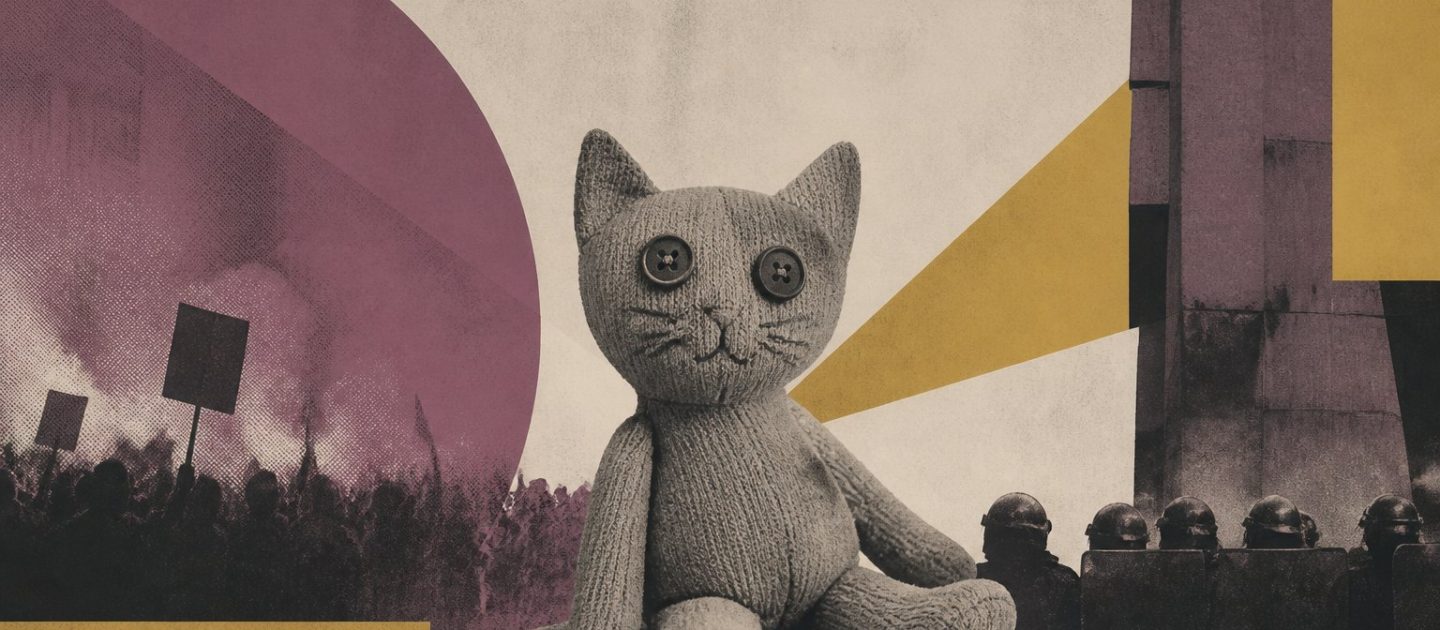
Between 2005 and 2017, a small stuffed cat named Pinky — gray, handmade, button-eyed — delivered some of the most incisive political commentary available on the internet. The Pinky Show, a web series created by the anonymous collective behind Pinky and her co-host Daisy, used the format of an educational children’s program to address subjects that most actual educational programming would never touch: settler colonialism, the prison-industrial complex, the ideological function of public schooling, the history of U.S. military intervention, and the epistemological foundations of white supremacy. Episodes were typically five to fifteen minutes long, shot on a tabletop set, and narrated in Pinky’s gentle, earnest, slightly bewildered voice — a voice that somehow made the demolition of received ideas feel like the most natural thing in the world.
Radical Pedagogy in Miniature
The Pinky Show belongs to a tradition of radical pedagogy that runs from Paulo Freire’s Pedagogy of the Oppressed through the free school movement to contemporary experiments in critical education. But it accessed this tradition through a medium — the web video — and a format — the puppet show — that were entirely its own. The choice of format was not arbitrary. By using stuffed animals as presenters, the creators of The Pinky Show accomplished several things simultaneously. They depersonalized the delivery of potentially threatening ideas, removing the human face that audiences might judge, dismiss, or fetishize. They invoked the aesthetics of childhood education, creating a dissonance between form and content that was itself pedagogically productive. And they created characters — Pinky curious and earnest, Daisy skeptical and impatient — who modeled the process of critical inquiry as a dialogue rather than a lecture.
The pedagogical method of The Pinky Show was Socratic in the best sense: it proceeded by questioning assumptions rather than asserting conclusions. A typical episode might begin with an apparently simple question — “What is a nation?” or “Why do we go to school?” — and then, through a series of careful logical steps, arrive at conclusions that were anything but simple. The nation, Pinky might explain, is not a natural entity but a historical construction, maintained by violence and naturalized through education. School, Daisy might observe, is not primarily about learning but about socialization — about producing subjects who accept the existing order as inevitable. These are not original observations — they can be found in the work of Benedict Anderson, Michel Foucault, Ivan Illich, and many others — but The Pinky Show made them accessible without making them simplistic.
The Web as Counter-Public Sphere
The Pinky Show emerged in the early years of YouTube, a period when the web video was still a genuinely experimental medium. The platform was not yet dominated by algorithms optimized for engagement, and the possibility of reaching an audience outside the circuits of mainstream media felt real and unprecedented. For a project like The Pinky Show — too radical for public television, too earnest for comedy, too pedagogical for the art world — YouTube offered a distribution channel that no previous technology had provided.
The show’s audience was never large by mainstream standards, but it was deeply engaged. Comments sections — in those years still sometimes capable of sustaining genuine conversation — became extensions of the episodes, with viewers debating, challenging, and building on the ideas presented. The Pinky Show also maintained a website with extensive supplementary materials: reading lists, discussion guides, and essays that expanded on the themes of individual episodes. The project was, in other words, not just a series of videos but an educational infrastructure — a miniature counter-institution operating within the interstices of the commercial internet.
This infrastructure was maintained by a small collective working with minimal resources. The production values of The Pinky Show were deliberately modest: tabletop sets, static cameras, hand-drawn graphics. This austerity was partly a matter of necessity — the project had no institutional funding — but it was also an aesthetic and political choice. The roughness of the production communicated authenticity and accessibility. It said: you do not need a studio, a budget, or a degree in media production to participate in the creation of critical knowledge. You need only a camera, a subject, and the willingness to think carefully.
Animation, Anonymity, and the Refusal of Celebrity
The anonymity of The Pinky Show’s creators was not incidental but central to the project’s politics. In a media landscape that increasingly rewards personal branding, self-promotion, and the cultivation of celebrity, the decision to remain anonymous was a deliberate refusal. It shifted attention from the messenger to the message, from the personality of the speaker to the quality of the argument. It also protected the creators from the retribution that can follow from publicly challenging powerful institutions and ideologies — a practical consideration that should not be underestimated.
The use of puppet characters extended this logic. Pinky and Daisy were not alter egos or avatars of their creators; they were pedagogical devices, designed to facilitate learning rather than to express individual subjectivity. The warmth and humor of the characters — Pinky’s wide-eyed curiosity, Daisy’s sardonic impatience — served a pedagogical function: they made difficult ideas approachable without trivializing them. The puppet format also allowed for a kind of intellectual freedom that a human presenter might have found more difficult to sustain. A stuffed cat can say things that a human face cannot, not because the content is more extreme but because the format creates a productive distance between the idea and its delivery.
Legacy and Disappearance
The Pinky Show ceased producing new content around 2017. No announcement was made; the videos simply stopped appearing. The website remained online for some time before it, too, went dark. The reasons for the project’s end are unknown — the creators’ anonymity extended to their departure — but the timing suggests that the changing landscape of the internet may have played a role. By 2017, YouTube had been thoroughly colonized by commercial content, algorithmic recommendation had replaced organic discovery, and the dream of the web as a counter-public sphere had largely given way to the reality of the web as a surveillance-driven attention market.
Yet the legacy of The Pinky Show persists, even if it is difficult to quantify. The videos remain available in scattered corners of the internet, shared by teachers, activists, and self-directed learners who continue to find them illuminating. The project demonstrated that political education does not require institutional authority, professional production values, or celebrity endorsement. It requires only clarity of thought, honesty of purpose, and a form adequate to the ideas it conveys. In this, The Pinky Show stands as a quiet but significant example of what political art can accomplish when it takes pedagogy seriously — not as a supplementary function of art but as its primary vocation.
The proposition that truth is concrete — the insistence that ideas must be tested against material realities, that abstraction without practice is empty — finds an unlikely but fitting embodiment in The Pinky Show. A stuffed cat on a tabletop, speaking plainly about colonialism and capitalism, reaches more people and changes more minds than many a lavishly funded museum exhibition. This is not a romantic claim about the superiority of the marginal; it is an observation about the conditions of contemporary political communication, in which the most effective pedagogy often occurs in the least expected places.