Talk
Social Choreography — Museu d’Art Contemporani, Barcelona, 2015
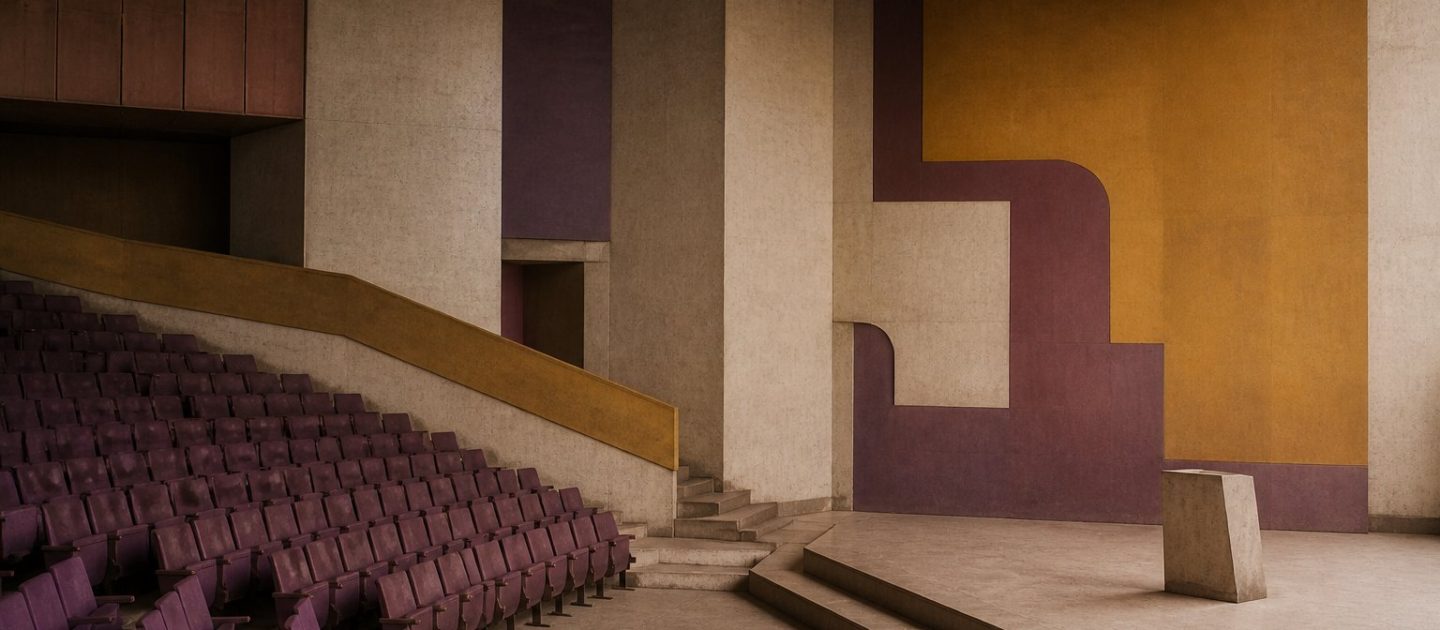
February 20–21, 2015 · MACBA, Barcelona
Speakers: Andrew Hewitt, Santiago Sierra, Carey Young
In February 2015, the Museu d’Art Contemporani de Barcelona (MACBA) hosted a two-day symposium exploring the concept of social choreography — the ways in which bodies are organized, directed, and disciplined within social and political space, and how artistic practice can intervene in these processes.
The theoretical anchor was provided by Andrew Hewitt, whose book Social Choreography (2005) had established the concept within cultural studies. Hewitt argued that choreography — understood not narrowly as dance but broadly as the aesthetic organization of human movement — has always been a political technology. From the court dances of absolutism to the mass gymnastics of totalitarian regimes to the controlled flows of bodies through contemporary airports and shopping centers, the choreographic management of movement is fundamental to the exercise of power. Art that engages with choreography, then, is necessarily engaging with politics, whether or not it intends to.
Santiago Sierra’s contribution was characteristically confrontational. He presented documentation of several works in which he had hired precarious workers to perform repetitive, meaningless physical tasks — standing in corners, holding up walls, being sprayed with polyurethane foam. Sierra framed these works as making visible the choreography of labour under capitalism: the way bodies are positioned, moved, and exhausted in the service of economic production. The ethical controversy surrounding his practice — the accusation that he exploits the very people he claims to represent — was addressed directly. Sierra’s position was that the discomfort his work produces is itself a form of political knowledge.
Carey Young presented her legal and corporate performance works, in which she inhabits the choreographies of business culture — the gestures, postures, and spatial arrangements of corporate life — in order to expose their ideological content. Her work suggests that the most pervasive social choreographies are those that appear most natural: the open-plan office, the boardroom, the networking event.
The symposium demonstrated that choreographic thinking offers a productive lens for analyzing political art — one that attends to bodies, spaces, and movements rather than representations and discourses alone.