Essay
The Graphic Project: Visual Communication as Political Practice
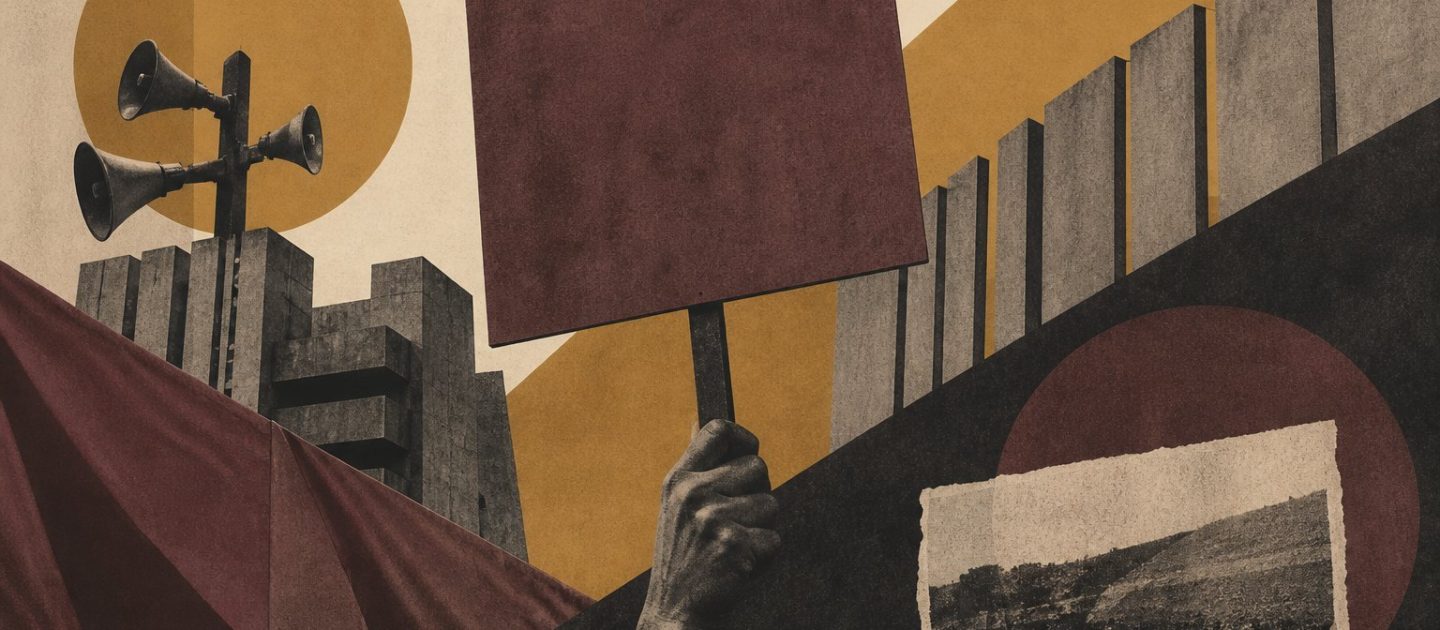
The graphic project — the mobilization of visual communication for political ends — is as old as the printed image itself. From the woodcuts of the Reformation to the broadsides of the French Revolution, from the photomontages of the Weimar Republic to the silkscreened posters of May 1968, the history of political art is inseparable from the history of graphic reproduction. Yet the relationship between graphic design and political practice has rarely been theorized with the seriousness it deserves. Design history tends to treat political graphics as a subcategory of commercial practice; art history tends to dismiss them as mere propaganda. Neither framework does justice to the complexity of what happens when visual communication becomes a form of political action.
Constructivism and the Promise of Visual Literacy
The Russian Constructivists were perhaps the first to articulate a coherent theory of the graphic project as political practice. For artists like El Lissitzky, Alexander Rodchenko, and Varvara Stepanova, the revolution demanded not only new social relations but new visual forms. The old aesthetics — illusionistic painting, decorative ornament, the bourgeois easel picture — were symptoms of the old order. The new society required a new visual language: rational, geometric, legible, democratic. Design was not a lesser art form but the highest, because it was the most socially embedded. A poster on a factory wall reached more people than a painting in a gallery. A book cover shaped more minds than a sculpture in a park.
Lissitzky’s famous declaration — “the electro-library will render the book obsolete” — was not a prediction about technology but a statement about the social function of visual communication. The point was not that books would disappear but that the graphic project could not remain confined to traditional formats. It had to expand into architecture, urban planning, exhibition design, typography — every domain where visual form shaped collective experience. The Constructivist legacy, for all its utopian excess, established a principle that remains relevant: that graphic design is never merely a vehicle for content but always also a form of content, and that the formal choices of the designer are always also political choices.
The Poster as Weapon
If Constructivism theorized the graphic project, the poster movements of the twentieth century practiced it. The history of political posters is too vast to summarize here, but certain moments stand out for their intensity and innovation. The Spanish Civil War produced some of the most visually powerful political graphics of the century — works by artists like Josep Renau that fused photomontage with bold typography in compositions of visceral urgency. The Cuban poster tradition, consolidated after 1959 through the work of organizations like OSPAAAL (Organization of Solidarity with the Peoples of Africa, Asia, and Latin America), developed a visual language that was simultaneously revolutionary and aesthetically sophisticated, drawing on pop art, psychedelia, and folk traditions to create images that circulated globally as icons of solidarity.
The Atelier Populaire of May 1968 in Paris represents perhaps the purest instance of the graphic project as collective political practice. During the weeks of the general strike, students and workers occupied the lithography workshops of the École des Beaux-Arts and produced hundreds of poster designs in a process that was deliberately anonymous and collaborative. The posters were not signed. They were not exhibited. They were wheat-pasted on walls, distributed at demonstrations, and passed from hand to hand. Their aesthetic — bold silhouettes, minimal text, flat colors — was dictated not by taste but by the constraints of rapid production and the need for immediate legibility. The Atelier Populaire demonstrated that the graphic project, at its most radical, dissolves the distinction between artist and audience, between production and distribution, between aesthetic object and political tool.
From Street to Screen: The Digital Graphic Project
The advent of digital tools and networked communication has transformed the graphic project without fundamentally altering its logic. The same principles that governed the Atelier Populaire — speed, legibility, reproducibility, collective authorship — now operate in the domain of social media graphics, memes, and viral images. The Occupy movement of 2011, with its iconic “We Are the 99%” slogan and its proliferation of hand-lettered signs, demonstrated that the graphic project could operate simultaneously in physical and digital space, with images produced in encampments circulating instantaneously through global networks.
Yet the digital transformation has also introduced new complications. The speed of circulation means that images are consumed and discarded more rapidly than ever. The algorithmic mediation of platforms like Instagram and Twitter means that political graphics must compete for attention with every other form of content. The ease of production means that the field is saturated, and the signal-to-noise ratio is often unfavorable. The graphic project in the digital age faces a paradox: the tools are more accessible than ever, but the conditions for sustained visual communication are in many ways more hostile.
Some contemporary designers and collectives have responded to this paradox by returning to material production — to risograph printing, screen printing, and other analog processes that resist the frictionless circulation of digital images. Others have embraced the logic of the meme, producing images that are deliberately rough, unfinished, and modifiable — designed not to be preserved but to be transformed, remixed, and recontextualized by others. Both strategies represent attempts to maintain the political efficacy of the graphic project under conditions that tend to reduce all images to equivalent units of content.
The Ethics of Visual Persuasion
Any serious consideration of the graphic project must eventually confront the question of propaganda. The same techniques that can be mobilized for liberation can also be mobilized for domination. The Nazi regime, notoriously, was as sophisticated in its use of graphic design as any revolutionary movement. The visual language of totalitarianism — monumental typography, heroic figuration, the aestheticization of mass spectacle — is not formally distinguishable from the visual language of emancipation. What distinguishes them is not form but context, intention, and the political relations within which images circulate.
This uncomfortable proximity between political graphics and propaganda has led some critics to reject the entire enterprise of visual persuasion as inherently manipulative. But this position is untenable. All communication involves persuasion. All visual representation involves framing, selection, and emphasis. The question is not whether graphic design should be political — it always already is — but how it should be political: with what degree of transparency, in whose interest, and with what relationship to truth.
The strongest political graphic work maintains a commitment to what we might call visual honesty — not the naive belief that images can be transparent windows onto reality, but the ethical discipline of making visible the conditions of one’s own production. The Atelier Populaire printed its posters in occupied workshops; Emory Douglas published his revolutionary illustrations in the Black Panther newspaper, distributed by party members on the street; the Guerrilla Girls wheat-pasted their statistical posters in the neighborhoods of the art world they critiqued. In each case, the graphic project was embedded in a broader practice of political organizing, and the images derived their force not from formal innovation alone but from the social relations that produced and circulated them.
Toward a Contemporary Graphic Project
The graphic project today operates in a landscape defined by the simultaneous abundance and devaluation of images. Political graphics are everywhere — on protest signs, social media feeds, merchandise, murals, wheat-pasted posters, and projected onto buildings. Yet this very ubiquity raises questions about efficacy. Does a well-designed protest graphic change minds, or does it merely circulate within networks of the already persuaded? Does the aestheticization of political messages enhance their power or neutralize it, transforming dissent into lifestyle branding?
These questions have no definitive answers, but they should not lead to paralysis. The graphic project remains one of the most accessible forms of political art — requiring minimal resources, reaching large audiences, and operating in the spaces of everyday life rather than the sequestered precincts of galleries and museums. At its best, it does what all political art aspires to do: it makes visible what power would prefer to keep hidden, it gives form to inchoate feelings of injustice, and it creates, however briefly, a shared visual language for collective aspiration. The history of the graphic project, from Constructivism to the present, is a history of these moments — fragile, contested, and indispensable.