Essay
Documentary Turns: Photography, Evidence, and Political Truth
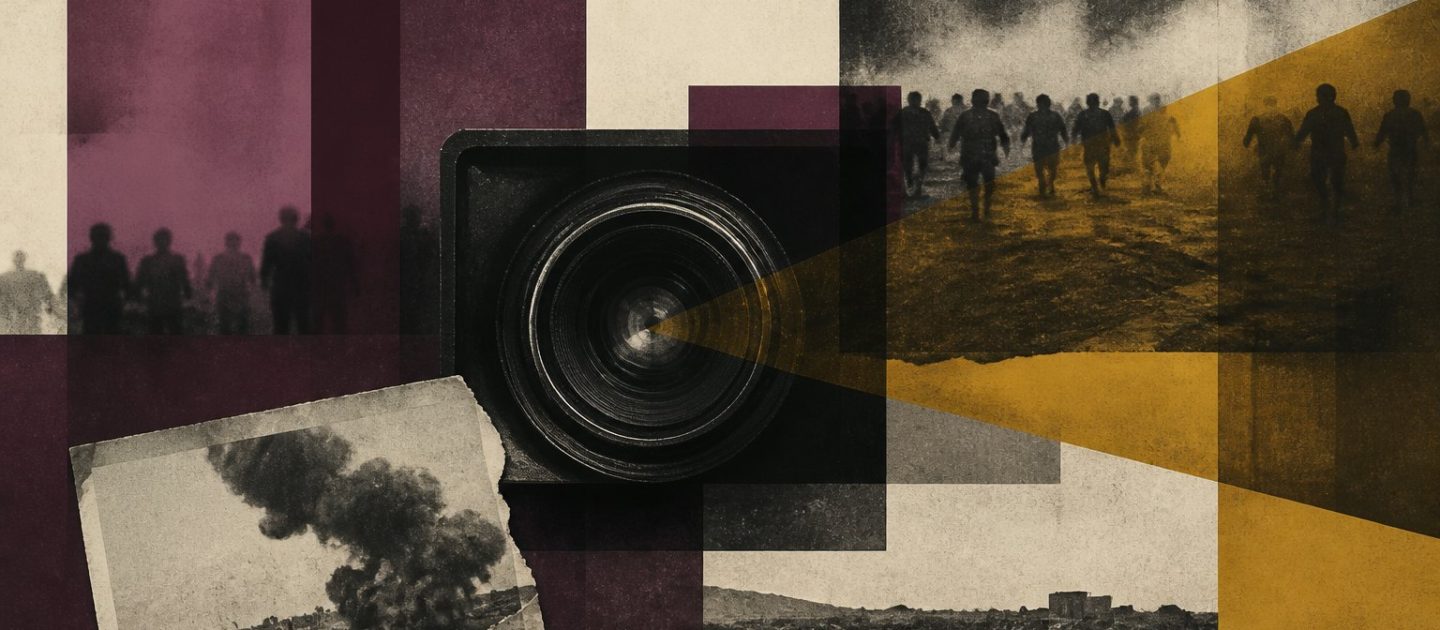
The relationship between photography and political truth has never been stable. From the earliest war photographs — Roger Fenton’s carefully staged Crimean landscapes, Alexander Gardner’s controversially repositioned dead at Gettysburg — to the smartphone footage that has defined twenty-first-century protest movements, the camera has served simultaneously as an instrument of evidence and a tool of manipulation, a means of witnessing and a technology of surveillance. The “documentary turn” in contemporary art, which has seen a proliferation of practices that deploy photographic and filmic strategies to investigate political realities, inherits this ambiguity. It does not resolve it. But it does, at its best, make the ambiguity itself visible — transforming the question of what a photograph can prove into a question about the conditions under which evidence is produced, circulated, and believed.
The Crisis of the Document
The notion that documentary photography occupies a privileged relationship to truth — that the photograph, by virtue of its indexical connection to the real, provides unmediated access to the world as it is — has been under sustained critique since at least the 1970s. The work of Allan Sekula, Martha Rosler, and Victor Burgin, among others, demonstrated that the documentary photograph is not a transparent window onto reality but a constructed image, shaped by the conventions of genre, the intentions of the maker, the context of display, and the institutional frameworks within which it circulates. The photograph does not simply record; it frames, selects, and interprets. Its evidentiary status is not given but produced — a function of the social and discursive systems that confer authority on certain images and deny it to others.
This critique did not destroy documentary photography. It did, however, transform it. The most significant documentary practices of the past three decades — from Sekula’s own monumental Fish Story, a seven-year investigation of maritime labour and global logistics, to Fazal Sheikh’s sustained engagement with displacement and dispossession across multiple continents — have been shaped by an acute awareness of the medium’s limitations. They do not claim to deliver the truth. They claim, more modestly, to contribute to the conditions under which truth might become visible — and to interrogate the forces that render it invisible.
Steyerl and the Politics of the Image
No contemporary artist has explored the crisis of the documentary image with greater rigour or influence than Hito Steyerl. Trained as a documentary filmmaker, Steyerl has developed a practice — spanning video, installation, writing, and performance — that takes the conditions of image production and circulation as its primary subject. Her 2009 essay “In Defense of the Poor Image,” published in e-flux journal, has become one of the most cited texts in contemporary art discourse. In it, Steyerl argues that the degraded, low-resolution images that proliferate online — thumbnails, screenshots, compressed video files — constitute a new class of image whose political significance lies precisely in its dispossession. The poor image has been “dragged through slow digital connections, compressed, reproduced, ripped, remixed, as well as copied and pasted into other channels of distribution.” It has lost quality, resolution, and aura. But in doing so, it has gained something else: mobility, accessibility, and a kind of democratic availability that the high-resolution image, locked behind paywalls and institutional gates, cannot match.
Steyerl’s analysis is characteristically dialectical. She does not celebrate the poor image as a site of liberation or denounce it as a symptom of degradation. She traces the contradiction: the same conditions that democratise image circulation — the proliferation of platforms, the collapse of distinctions between production and consumption, the acceleration of sharing — also render images vulnerable to manipulation, decontextualisation, and weaponisation. The poor image is both a tool of the powerless and a product of the systems that produce powerlessness. Its political meaning is never settled; it is determined by the specific contexts and struggles in which it circulates.
Steyerl’s video works — How Not to Be Seen: A Fucking Didactic Educational .MOV File (2013), Liquidity Inc. (2014), Factory of the Sun (2015) — extend this analysis into the domain of installation and performance. They explore the conditions of visibility and invisibility under digital capitalism: the drone’s gaze, the surveillance camera’s eye, the resolution grids that determine who and what is visible at what scale. They are, in a sense, documentaries about the impossibility of documentary — investigations of a media environment in which the very concept of photographic evidence has been rendered unstable by the technologies that produce it.
Forensic Aesthetics
If Steyerl’s work diagnoses the crisis of documentary evidence, the practice of Forensic Architecture — the research agency founded by the architect Eyal Weizman at Goldsmiths, University of London, in 2010 — represents an attempt to reconstruct evidentiary practice on new foundations. Forensic Architecture uses spatial analysis, architectural modelling, open-source intelligence, machine learning, and witness testimony to investigate instances of state violence, environmental destruction, and human rights abuse. Its investigations have addressed the bombing of hospitals in Syria, the shooting of migrants at the Greek-Turkish border, the use of tear gas against civilian populations, and the environmental impact of corporate extraction in Guatemala and Indonesia, among many other cases.
The practice’s relationship to documentary photography is complex. Forensic Architecture does not simply document events; it reconstructs them, using multiple evidentiary sources — satellite imagery, amateur video, acoustic analysis, architectural plans — to produce composite representations that no single photograph could provide. The resulting images are not documents in the traditional sense. They are models, simulations, and spatial analyses that make visible what individual photographs cannot: the trajectory of a bullet, the blast radius of a bomb, the pattern of a military operation. They transform the document from a record of the visible into an instrument for disclosing the invisible.
This practice has been enormously influential, generating a wave of “forensic” or “investigative” aesthetics that extends well beyond Weizman’s immediate circle. Artists and collectives including Susan Schuppli, Lawrence Abu Hamdan, and the Centre for Research Architecture have developed practices that apply similar methods — spatial analysis, open-source investigation, material witness — to a range of political and environmental questions. The result is a body of work that reclaims the evidentiary function of the image while remaining fully aware of the critiques that rendered that function problematic in the first place.
The Smartphone and the Witness
The proliferation of smartphone cameras has transformed the conditions of documentary practice in ways that neither traditional photojournalism nor contemporary art fully anticipated. The footage of Eric Garner’s killing by NYPD officers in 2014, recorded by bystander Ramsey Orta on a mobile phone, became one of the most consequential documents of American political life — and one of the most contested. The footage was clear, its content unambiguous, and yet it failed, in the legal sense, to produce accountability: the officers involved were not indicted. The gap between what the image showed and what the legal system was prepared to acknowledge became, itself, a political fact of the first order.
This gap — between evidence and justice, between visibility and accountability — has become a central preoccupation of contemporary documentary practice. The filmmaker and artist Laura Poitras, whose work spans the Edward Snowden revelations (Citizenfour, 2014), the surveillance state (Astro Noise, 2016), and the Oxycontin crisis (All the Beauty and the Bloodshed, 2022), has explored how the production of evidence — its accumulation, its classification, its institutional processing — shapes and often distorts the political realities it purports to represent. Her work makes visible not only the events themselves but the systems of documentation, classification, and archiving through which those events are rendered legible or illegible to public discourse.
Truth in the Age of Synthetic Media
The emergence of synthetic media — deepfakes, AI-generated images, algorithmically manipulated video — has introduced a new chapter in the crisis of photographic truth. If the critique of documentary in the 1970s and 1980s demonstrated that photographs were always constructed, the emergence of synthetic media threatens to dissolve the indexical connection between photograph and referent altogether. An AI-generated image of a political event need not correspond to any actual occurrence; a deepfake video can make a public figure appear to say things they never said. The result is not merely a proliferation of false images but a generalised erosion of the evidentiary status of the image as such — what the media theorist Joan Donovan has called the “liar’s dividend,” in which the mere possibility of fabrication is used to discredit authentic documentation.
Artists have responded to this crisis in various ways. Trevor Paglen’s investigations of machine vision — his photographs of classified military installations, his taxonomies of AI training datasets, his collaborations with computer scientists to reveal the biases embedded in facial recognition systems — have sought to make visible the otherwise invisible infrastructure of algorithmic image production. Zach Blas’s Facial Weaponization Suite, which produces collective face masks from aggregated biometric data, proposes opacity and refusal as strategies of resistance against the surveillance gaze. These practices do not restore the truth-telling capacity of the photograph. They do something more difficult: they make the conditions of image production and circulation themselves available for scrutiny and contestation.
The Document as Practice
The documentary turn in contemporary art is not a return to a naive faith in photographic truth. It is, rather, a sustained investigation of the conditions under which truth claims are produced, contested, and rendered politically effective. At its best, it combines the evidentiary rigour of investigative practice with the critical self-awareness of contemporary art, producing work that neither accepts the photograph at face value nor abandons the possibility of evidence altogether. In a moment of profound epistemic crisis — when the distinction between fact and fabrication is under sustained assault from state actors, corporate interests, and technological systems alike — this combination of rigour and reflexivity is not merely aesthetically interesting. It is politically indispensable.
The document, in this context, is not a fixed object but an ongoing practice: a continual process of gathering, assembling, testing, and presenting evidence under conditions of uncertainty. It is a practice that requires both the photographer’s attentiveness to the visible and the critic’s awareness of the forces that structure visibility. It requires, in short, the kind of double consciousness that the best documentary art has always demanded — an awareness that the camera both reveals and conceals, that evidence is both discovered and constructed, and that the pursuit of political truth is never a matter of simply pointing the lens at the world and pressing the shutter.