Essay
The Artist as Organiser: From Beuys to BLM
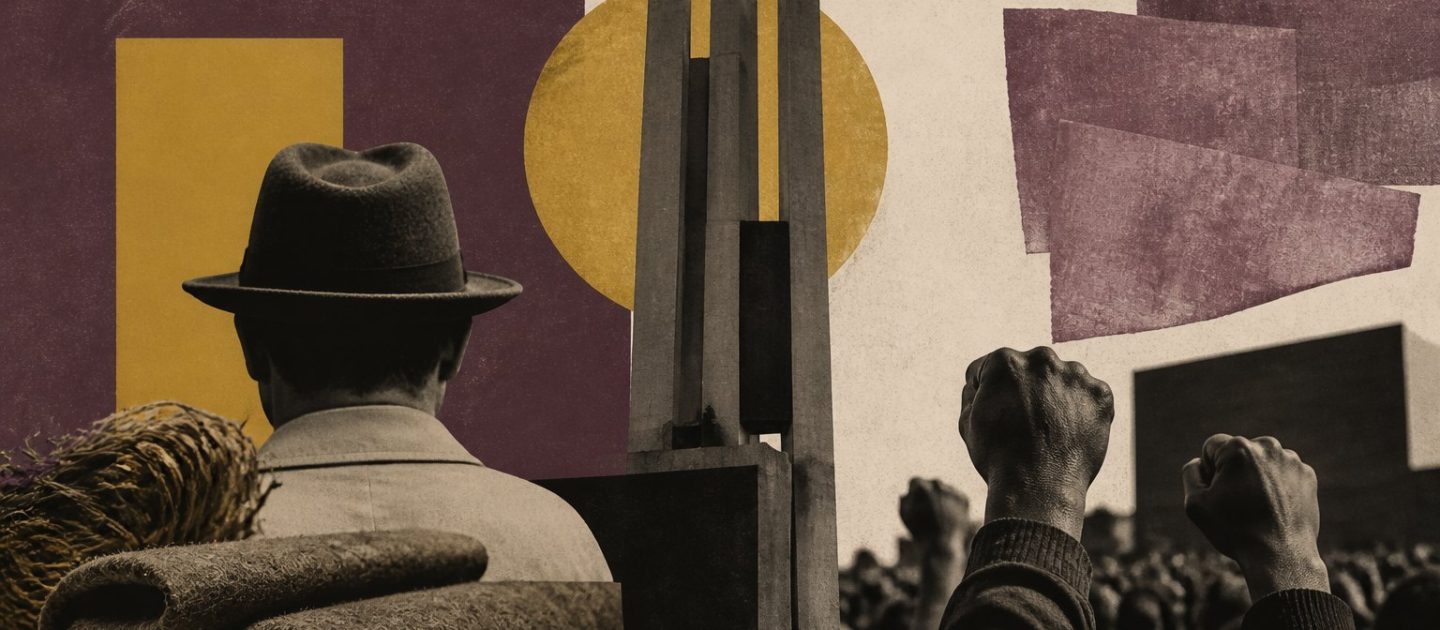
The figure of the artist-as-organiser — the practitioner who moves between the studio and the street, between aesthetic production and political mobilisation — is not new. It has antecedents in the productivism of the 1920s, the situationist dérive, the happenings and Fluxus events of the 1960s. But the contemporary iteration of this figure, shaped by the social movements of the 2010s and early 2020s, represents something genuinely distinct: not merely the artist who engages in politics but the artist whose primary medium is organisation itself — the building of coalitions, the creation of infrastructure, the facilitation of collective action. To trace this trajectory from Joseph Beuys’s concept of “social sculpture” to the visual cultures of Black Lives Matter is to track a fundamental transformation in how artists understand their relationship to political life.
Beuys and the Expanded Field of Sculpture
When Joseph Beuys declared that “every human being is an artist,” he was not making a populist gesture or a romantic claim about innate creativity. He was proposing a redefinition of art itself: an expansion of the concept of sculpture to encompass the entire field of social relations. For Beuys, sculpture was not limited to the manipulation of physical materials — fat, felt, iron, copper — but extended to the shaping of thought, the formation of institutions, the organisation of social life. His concept of “social sculpture” (Soziale Plastik) envisioned a practice in which the creation of alternative social forms — schools, political parties, economic cooperatives — was itself an artistic act, continuous with and not inferior to the production of objects for exhibition.
Beuys’s most ambitious organisational project was the Free International University (FIU), founded in 1973 in Düsseldorf, which sought to create a counter-institution for interdisciplinary research and education outside the constraints of the state university system. The FIU produced no degrees, conferred no credentials, and operated on a shoestring budget; it was, in Beuys’s terms, a sculpture — a provisional social form shaped by collective intention. His involvement in the founding of the German Green Party in 1980, while controversial among both artists and politicians, was similarly motivated: the party was, for Beuys, another sculptural material, another medium through which social reality could be shaped.
The limitations of Beuys’s model are well documented. His insistence on the artist’s special role — the artist as shaman, as healer, as visionary — sat uneasily with his democratic rhetoric. The charismatic authority he exercised within his own projects reproduced, in many critics’ view, the very hierarchies that social sculpture was meant to dissolve. Benjamin Buchloh’s devastating critique — that Beuys’s practice represented a regression to pre-modern models of artistic authority, a “twilight of the idol” dressed in the rhetoric of liberation — remains a powerful corrective to any uncritical celebration of the artist-as-organiser.
The 1990s: From Object to Process
The 1990s saw a significant shift in the relationship between art and organisation. The end of the Cold War, the rise of globalisation, and the proliferation of new communication technologies created conditions in which the organisational dimension of artistic practice could take new forms. Groups like the Danish collective Superflex, the Slovenian collective IRWIN, and the German-Austrian duo WochenKlausur developed practices that were explicitly organisational: Superflex created tools for economic self-determination (biogas units, free beer recipes, alternative internet infrastructure); WochenKlausur brokered concrete social interventions (a floating health clinic for sex workers in Zurich, a boarding house for homeless women in Vienna).
These practices differed from Beuys’s social sculpture in important respects. They were collaborative rather than charismatic, pragmatic rather than visionary, specific rather than universal. They did not claim to transform society through the artist’s special insight but rather to create functional tools and infrastructures that could be used, modified, and reproduced by others. The artist was no longer a shaman but an organiser, a facilitator, a builder of platforms. This shift — from the artist as exceptional subject to the artist as infrastructural agent — would prove enormously influential for the generation of practitioners that followed.
Occupy and the Aesthetics of Assembly
The square occupations of 2011-2013 — Occupy Wall Street, the indignados, Tahrir — represented a new chapter in the relationship between art and organisation. Many of the occupations’ key participants were artists, designers, and cultural workers; many of the occupations’ most powerful aesthetic productions — the People’s Library, the Bat Signal projected onto the Verizon Building, the cardboard signs that became icons of a generation’s economic frustration — were created by individuals trained in art schools and embedded in art-world networks. But the occupations were not art projects. They were political movements, organised through horizontal, consensus-based processes that drew on anarchist, feminist, and indigenous traditions of assembly.
The experience of the occupations had a profound effect on many artist-participants, catalysing a shift from making art about politics to doing politics as a form of creative practice. The artist Noah Fischer, a founder of Occupy Museums, has described this shift in terms of a “de-sublimation” — a movement from the sublimated politics of gallery art to the direct politics of the street, the courtroom, and the organising meeting. For Fischer and others, the occupations demonstrated that the most powerful aesthetic experiences were not to be found in museums but in the collective creation of alternative social realities — temporary, fragile, and imperfect as those realities inevitably were.
Black Lives Matter and the Visual Politics of Protest
The Black Lives Matter movement, which emerged in 2013 following the acquittal of George Zimmerman for the killing of Trayvon Martin and grew into a national and international force following the murders of Michael Brown, Eric Garner, Breonna Taylor, and George Floyd, represents perhaps the most significant convergence of art and organisation in the twenty-first century. Unlike Occupy, which was notable for its refusal of leadership and its horizontal organisational structure, BLM was founded by three organisers — Alicia Garza, Patrisse Cullors, and Opal Tometi — and developed a decentralised but identifiable organisational infrastructure through its network of local chapters.
The movement’s visual culture has been extraordinarily rich. The portraits of victims that became ubiquitous at marches and vigils — often painted in a style that combined photographic realism with graphic boldness — constituted a form of counter-memorial: a refusal to let the dead disappear into statistics. The murals that proliferated in the summer of 2020 — from the monumental George Floyd mural at 38th and Chicago in Minneapolis to the countless spontaneous paintings on boarded-up storefronts across the country — represented one of the most significant eruptions of public art in American history. The raised fist, the kneeling figure, the phrase “I can’t breathe” — these became aesthetic forms of extraordinary condensation, compressing complex political realities into immediately legible images and gestures.
Crucially, much of this visual production was created by artists — trained, self-taught, and amateur — who understood their work not as commentary on a political movement but as participation in it. The artist Nikkolas Smith, whose digital portraits of Breonna Taylor, Elijah McClain, and others were widely shared on social media, has described his practice as “artivism” — a term that, whatever its limitations, captures the refusal to separate aesthetic production from political commitment. The work is not made for galleries, though galleries have inevitably sought it out; it is made for the street, the screen, and the protest.
The Organiser’s Aesthetic
What distinguishes the contemporary artist-as-organiser from earlier models is a specific quality of aesthetic attention to the processes of organisation themselves. The meetings, the phone trees, the social media strategies, the mutual aid networks, the bail funds, the legal observer trainings — all of these are understood not merely as political necessities but as forms of creative practice, as material to be shaped with the same care and intentionality that an artist brings to any other medium. This is not Beuys’s social sculpture, with its charismatic artist-shaman at the centre. It is something more distributed, more collective, more pragmatic: an organisational aesthetics rooted in the specific needs and capacities of particular communities and struggles.
The artist and organiser Patrisse Cullors, before co-founding BLM, studied at a variety of Los Angeles art institutions and has consistently described her organising work in aesthetic terms — as a practice of “world-making” that draws on performance, ritual, and collective imagination. The dancer and choreographer nora chipaumire has explored the relationship between movement, protest, and bodily autonomy in works that blur the line between concert dance and political action. The architect and artist Emanuel Admassu, through his practice Adjaye Associates and his independent work, has investigated how spatial design can serve as a tool for racial justice and community self-determination.
Beyond the Studio, Beyond the Street
The trajectory from Beuys to BLM is not a smooth line of progress. It is marked by ruptures, reversals, and unresolved contradictions. The charismatic model of the artist-as-visionary has not disappeared; it has been complicated, challenged, and in some contexts reinscribed. The institutional absorption of social practice — the museum’s capacity to exhibit, fund, and thereby neutralise organisational art — remains a persistent problem. The relationship between aesthetic production and political efficacy remains uncertain: does the mural contribute to the movement, or does it substitute for it? Does the artist-organiser strengthen collective power, or does the emphasis on artistry divert attention from the unglamorous work of base-building and policy change?
These questions do not admit of definitive answers. But the arc from social sculpture to social movement suggests at least one provisional conclusion: the most generative relationship between art and organisation is not one in which art serves politics or politics serves art, but one in which the two practices inform and transform each other. The artist-as-organiser does not merely apply aesthetic skills to political problems; she brings to the work of organisation a quality of attention — to form, to process, to the sensory dimensions of collective life — that transforms the meaning and experience of political action. And the organiser-as-artist does not merely illustrate political commitments; she discovers, in the practice of building movements, aesthetic possibilities that the studio could never have generated alone.
This mutual transformation is neither guaranteed nor automatic. It requires a willingness to work across institutional boundaries, to risk the loss of professional identity, to inhabit the uncomfortable space between disciplines. But it is, perhaps, the most vital form of artistic practice available in a moment when the crises of the political and the crises of the aesthetic are not two separate problems but one.