Artist
Jonas Staal
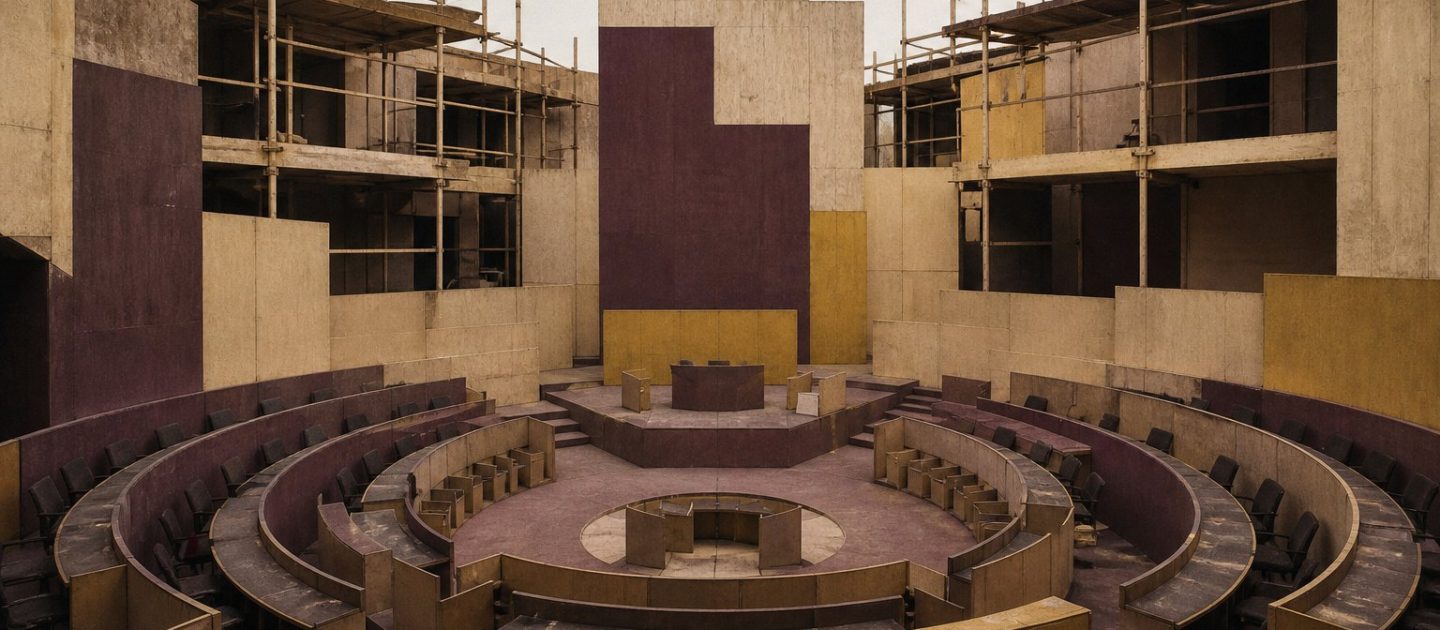
Dutch artist and researcher whose practice treats propaganda, parliamentary form, and political organization as artistic media, constructing alternative infrastructures for stateless and extra-parliamentary political movements.
Biographical Overview
Jonas Staal (b. 1981, Zwolle, Netherlands) studied at the Ateliers in Amsterdam and completed a doctorate at the University of Leiden with a dissertation on art and propaganda. His practice operates across installation, publication, institutional design, and what he terms “assemblism” — the construction of temporary and permanent organizational forms that function simultaneously as artworks and as political infrastructure.
Staal’s most prominent project, New World Summit (2012–ongoing), establishes alternative parliamentary spaces for organizations excluded from established democratic processes — including stateless Kurdish political movements, Zapatista autonomous governance structures, and progressive movements operating under conditions of political repression. Each summit constructs a purpose-built parliament in a host city, complete with architectural design, speaker programs, and procedural frameworks, producing what Staal describes as a “propaganda artwork” that both represents and enacts alternative political organization.
Other significant projects include New Unions (2016–ongoing), a collaboration with the democratic self-administration of Rojava in northern Syria, which resulted in the construction of a public parliament and cultural center; and Court for Intergenerational Climate Crimes (2021), a speculative tribunal staging legal proceedings against fossil capital on behalf of future generations. Staal’s installations and interventions have been presented at the São Paulo Biennial, the Van Abbemuseum, the Moderna Museet, and the Oslo Architecture Triennale. He is the founder of the artistic and political organization IDEOLOGIE.
Relevance to Political Art and Activism
Staal’s work is distinguished by its refusal of the conventional relationship between art and politics in which art comments upon, critiques, or symbolically intervenes in political reality from a position of aesthetic autonomy. Instead, Staal’s projects construct political reality — they build parliaments, they convene assemblies, they draft constitutions. The artwork is not a representation of political possibility but its material instantiation.
His sustained engagement with propaganda as a category is particularly significant. Where liberal discourse treats propaganda as the antithesis of democratic communication, Staal argues — drawing on the work of Jacques Ellul and more recent media theory — that all political communication is propagandistic, and that the relevant question is not whether propaganda exists but who controls its production and to what ends. By reclaiming propaganda as an artistic medium, Staal opens a space for examining the aesthetic dimensions of political organization that conventional art-world frameworks of criticality tend to foreclose. His collaboration with the Rojava revolution represents perhaps the most consequential test of this proposition: art not as commentary on politics but as a constitutive element of revolutionary governance.
Biographical details sourced from publicly available exhibition records, published writings by the artist, and institutional documentation. Theoretical references draw on established scholarship in propaganda studies and political aesthetics.